
Why Most SaaS Content Strategies Miss the Best Source of SEO Insight
Most SaaS companies already have everything they need for a strong content strategy. The problem is that their strategy rarely starts with the one source that reveals what customers are actually searching for: their own customers.
The usual process goes something like this: the marketing team gets together, brainstorms relevant topics, and starts publishing. The writing is often solid. The ideas are thoughtful. But the topics are usually chosen based on what the company wants to say — not what potential customers are searching for.
That gap is where most SaaS content strategies quietly break down.
Your customers are already telling you what to write
When I reviewed the blog of a project management SaaS recently, the content was genuinely good. Well-written, clearly a real effort. But the titles looked like this:
How We Built Our Onboarding Flow
Behind the Scenes: Our Q2 Product Update
The Future of Project Management
Great for existing users. Not how new customers find you.
When I pulled customer interview transcripts from a similar company, the language was completely different. People described their problems like this:
"I can't get my team actually to adopt the tool."
"We keep losing users in the first week, and I don't know why."
"I have no visibility into where people drop off."
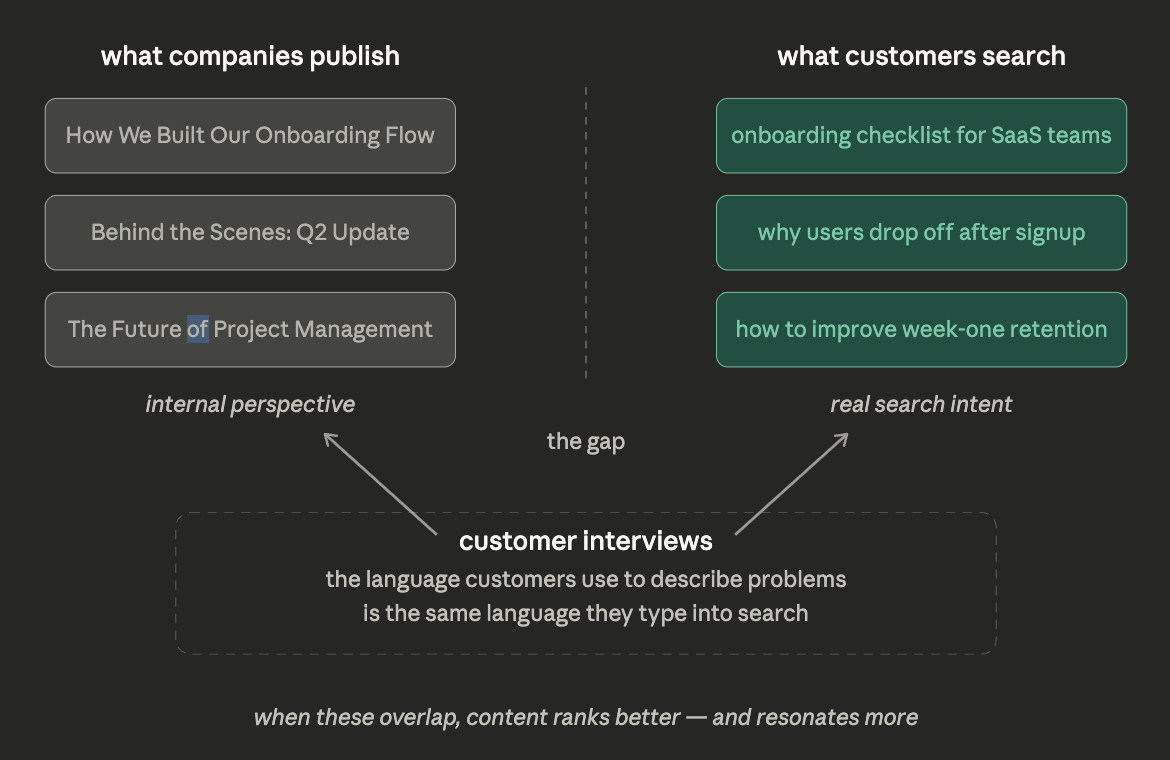
Diagram comparing SaaS blog topics to real customer search queries, showing the language gap between internal publishing and search intent.
That language — specific, frustrated, searching for a solution — often maps almost directly to how those same people search Google:
onboarding checklist for SaaS teams
why users drop off after signing up
how to improve week-one retention
High intent. Real problems. Nobody on the internal team brainstormed those phrases — but customers handed them over for free.
Customer research is an underused SEO asset
Most SaaS teams conduct customer interviews, usability sessions, or discovery calls at some point. Those conversations are usually treated as product inputs. Rarely do they make their way into content planning.
That's a missed opportunity.
Interview transcripts are full of recurring phrases, frustrations, and questions that customers can’t find good answers to. Those patterns are some of the most reliable signals for what to write about — because they reflect how real people describe real problems, not how an internal team talks about its product.
A SaaS content strategy built around that language tends to do two things well. It ranks better because the content aligns with how people actually search. And it resonates more when people land on it, because it sounds like someone understood the problem before writing a single word.
A strong SaaS content strategy often starts by understanding how customers describe their problems — and then turning those insights into SEO-driven topics.
Where Customer Insight and SEO Actually Meet
The shift isn't complicated, but it does require a different starting point.
Instead of asking "what should we write about this quarter?" — start with "what are customers saying, and what are they searching for?" Pull from interview notes. Review support tickets. Look at the questions that come up on sales calls. Then check whether those phrases have search volume behind them.
The overlap is almost always bigger than teams expect.
If you’re a SaaS founder or marketing leader and you’re not sure whether your content reflects how customers actually talk about their problems, it’s usually worth taking a closer look.
It’s a pattern I see across many SaaS blogs — and fixing it often unlocks far more search visibility than teams expect.
Frequently Asked Questions
-
Description text gCustomer interviews often reveal the exact language people use to describe their problems. Those same phrases frequently show up in search queries. When SaaS companies build content around real customer language, it aligns more closely with search intent and tends to perform better in organic search.oes here
-
A strong SaaS content strategy connects three things: real customer problems, search intent, and helpful content. Instead of publishing product updates or company news, effective SaaS blogs focus on answering the questions potential customers are actively searching for.
-
The best results usually come from combining both. Customer insights reveal how people describe their problems, while keyword research shows how often those problems are searched for. When those two sources overlap, companies often discover the most valuable content opportunities.